




Outlining who's building Ethereum, what they're building, and why it matters for finance. We start with the base layers: Foundation, Standards & Infrastructure.
Builders Pt.1
Outlining who's building Ethereum, what they're building, and why it matters for finance. We start with the base layers: Foundation, Standards & Infrastructure.
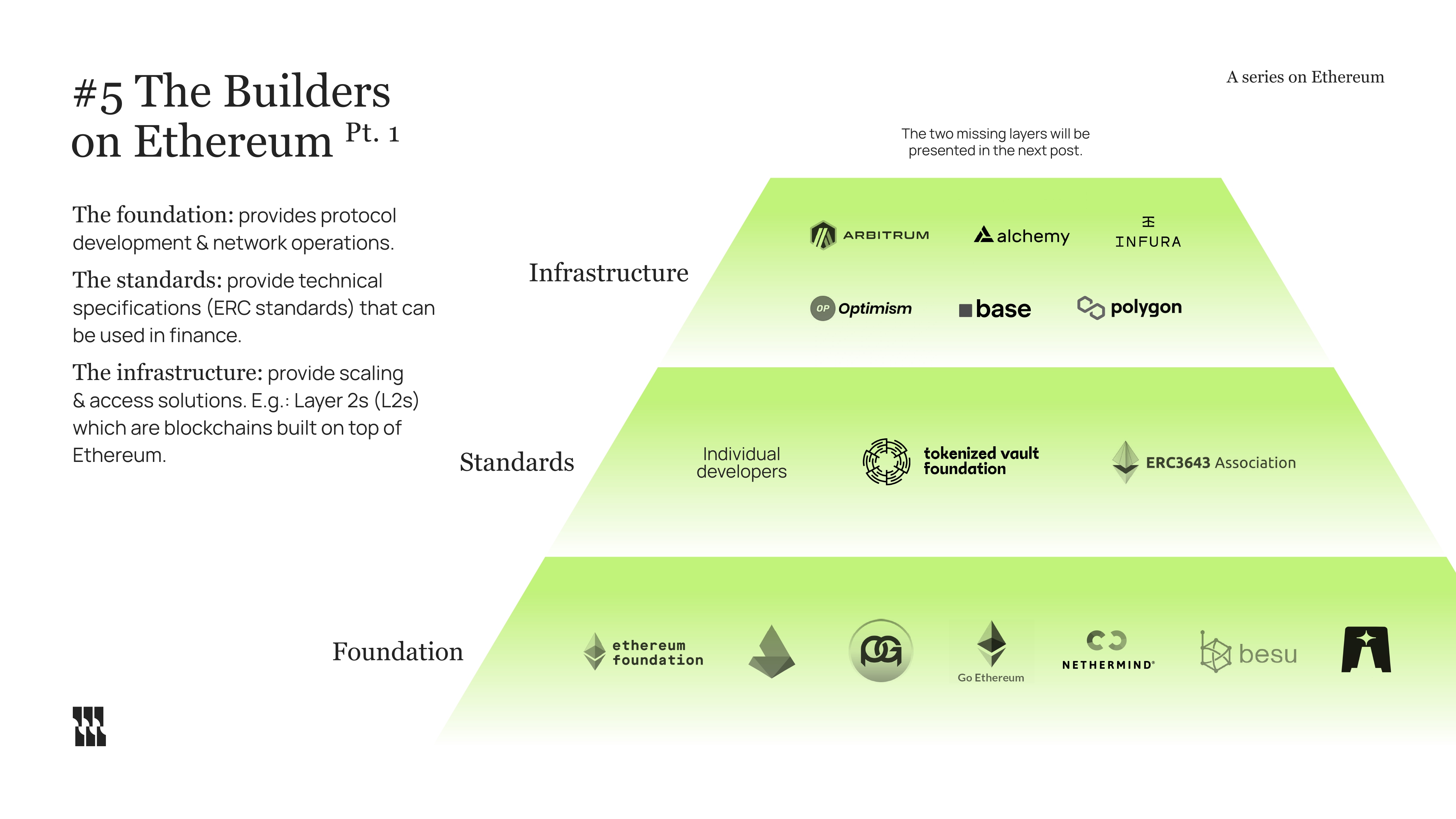
The Foundation:
Protocol Development & Network Operations
Who: The Ethereum Foundation, All Core Devs, Client Teams (Geth , Besu, Lighthouse, Prysm), Protocol Guild
What they do: These groups conduct protocol research, coordinate network upgrades, develop software that runs the network, and provide grants to ecosystem builders (such as to Ray Buckton and Ivie Satijn). These teams maintain the diverse implementations that keep Ethereum running 24/7.
Why it matters for finance: This layer ensures the 99%+ network uptime and reliability that institutions require for settlement. On top of that, the fact that the network is run by multiple independent client implementations means that there is no single-point-of-failure. No single software bug can take down the network, which is critical for financial infrastructure handling billions in daily transactions.
The Standards:
Technical Specifications for Finance
Who: Individual developers and organizations like the ERC3643 Association and the Tokenized Vault Foundation.
What they do: These groups create, refine, and promote technical standards (ERCs) that define how financial instruments should function on Ethereum. They ensure interoperability and compliance with regulatory requirements.
Why it matters for finance: Standards enable composability, different financial applications can seamlessly interact. The ERC-3643 standard, for example, embeds KYC/AML compliance directly into security tokens, allowing regulated assets to trade while maintaining investor restrictions automatically.
We will dive further into standards soon
The Infrastructure:
Scaling & Access Solutions
Who: Layer 2 networks (such as Optimism, Arbitrum, Base, Polygon), bridges and node operators (such as Infura and Alchemy)
What they do:
- Layer 2 networks are blockchains that sit on top of Ethereum (hence the name Layer 2). They bundle thousands of transactions into one. This then lowers the costs and boosts speed.
- Bridges allow for moving assets between different blockchains, for example between Ethereum and Base.
- Node operators provide "blockchain access points" for apps. In the context of traditional finance that could mean handling the technical infrastructure so platforms can read balances, execute trades, or query assets 24/7 without building their own servers.
Together, these platforms dramatically reduce transaction costs and increase throughput from 15-30 transactions per second to thousands, while maintaining Ethereum's security guarantees.
Why it matters for finance:
This infrastructure enables the massive transaction scale required for institutional adoption. If we want to create an onchain financial system, it needs to be able to process millions of transactions daily, or we can better just stick to the current system.
Final thoughts
These three layers form the foundation of the ethereum ecosystem. They enable all functions to work properly. But this is not all. Without any use cases there would not be a point of running this foundation.
In the next post we will discover the two missing laters and answer the questions: what can you build upon this foundation? And what does that mean for traditional finance?

