




Part 2. In the previous post, we covered Ethereum's foundational layers. Let’s continue with the two missing layers: Applications & Advocacy
Builders Pt.2
Part 2. In the previous post, we covered Ethereum's foundational layers. Let’s continue with the two missing layers: Applications & Advocacy
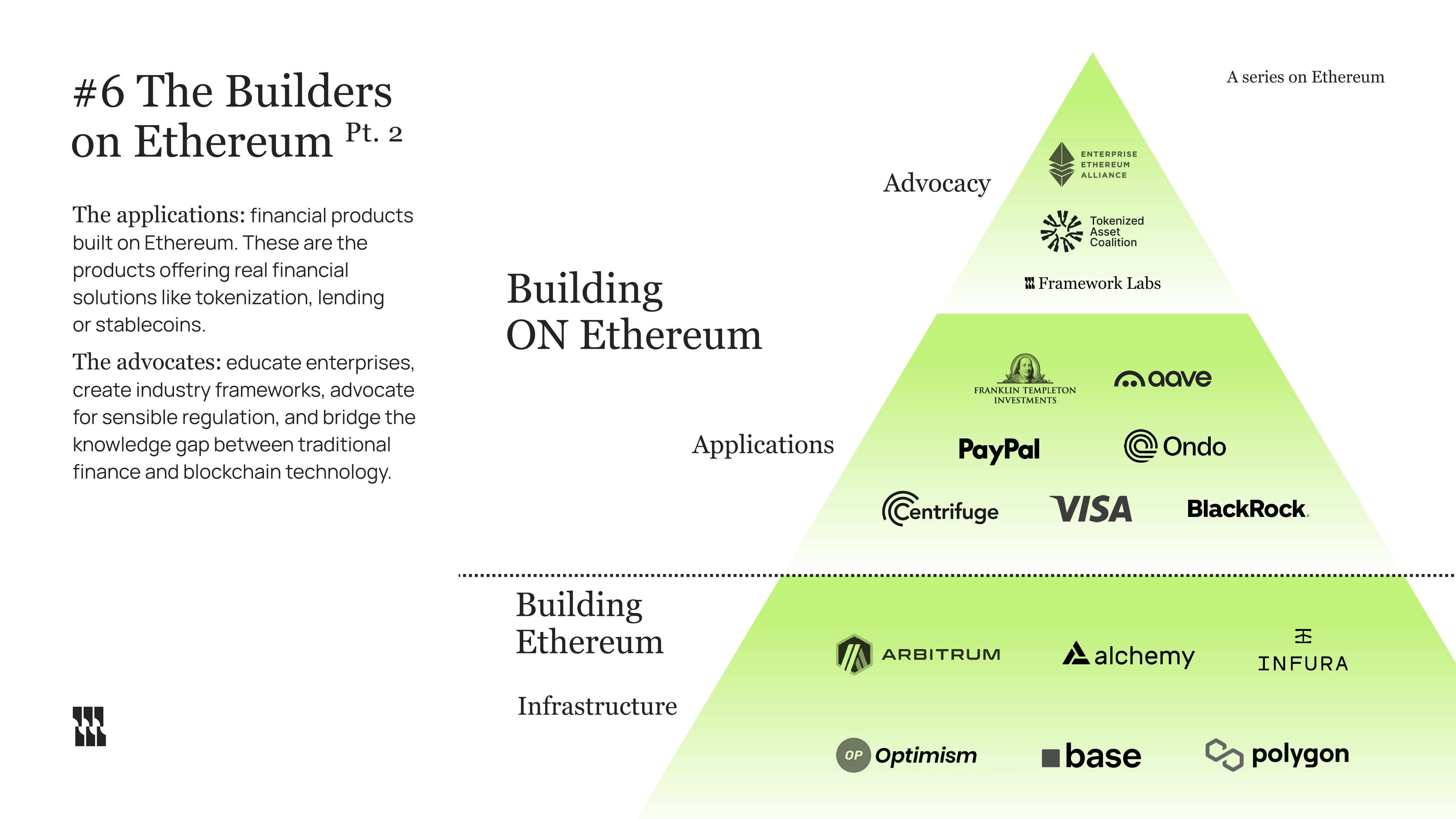
The Applications:
Financial Products Built on Ethereum
These are the products offering real financial solutions that are built on top of Ethereum.
Crypto-Native Builders:
- Centrifuge → Tokenized real-world assets
- Aave → Institutional lending vaults with compliance built-in
- Ondo → Tokenized treasuries and structured products
- Sky → Decentralized stablecoin (DAI) backed by real-world assets
- Maple → Institutional credit markets for tokenized debt
Traditional Finance Integration:
- BlackRock (BUIDL) → $500M+ tokenized money market fund on Ethereum
- Franklin Templeton → Launched OnChain U.S. Government Money Fund
- JP Morgan (Onyx) → Repo transactions and programmable payments on Ethereum
- Visa → USDC settlement and stablecoin payment infrastructure
- PayPal → PYUSD stablecoin for merchant settlements
Why it matters for finance: This layer proves that Ethereum is already production-grade infrastructure trusted by many financial institutions for real capital.
The Advocates:
Education & Industry Advancement
Who: Framework Labs, Ethereum Foundation, Ethereum Enterprise Alliance, Tokenized Asset Coalition, industry working groups
What they do: These organizations educate enterprises, create industry frameworks, advocate for sensible regulation, and bridge the knowledge gap between traditional finance and blockchain technology.
Why it matters for finance: Adoption requires education. These groups help financial institutions understand what's technically possible, navigate regulatory uncertainty, and connect with the right builders. They're accelerating the transition from "should we?" to "how do we?"
Final Thoughts
You’ve seen how the ethereum ecosystem is built up. As you might have noticed, it’s fundamentally different from the traditional financial infrastructure, especially due to the following two aspects:
No single point of failure → If any organization disappears tomorrow, the ecosystem continues. The Ethereum Foundation could dissolve, and the network would keep running through client teams, validators, and community coordination.
Aligned incentives without central control → All these organizations benefit from Ethereum's success, so they're naturally motivated to contribute, improve standards, and maintain quality.
This is what "decentralization" actually means in practice: resilient, continuously evolving infrastructure that no single entity controls but everyone can build on.
In the next post we will dive deeper into the standards layer. What is an ERC? How are technical standards created? And why do they matter for (onchain) finance?

